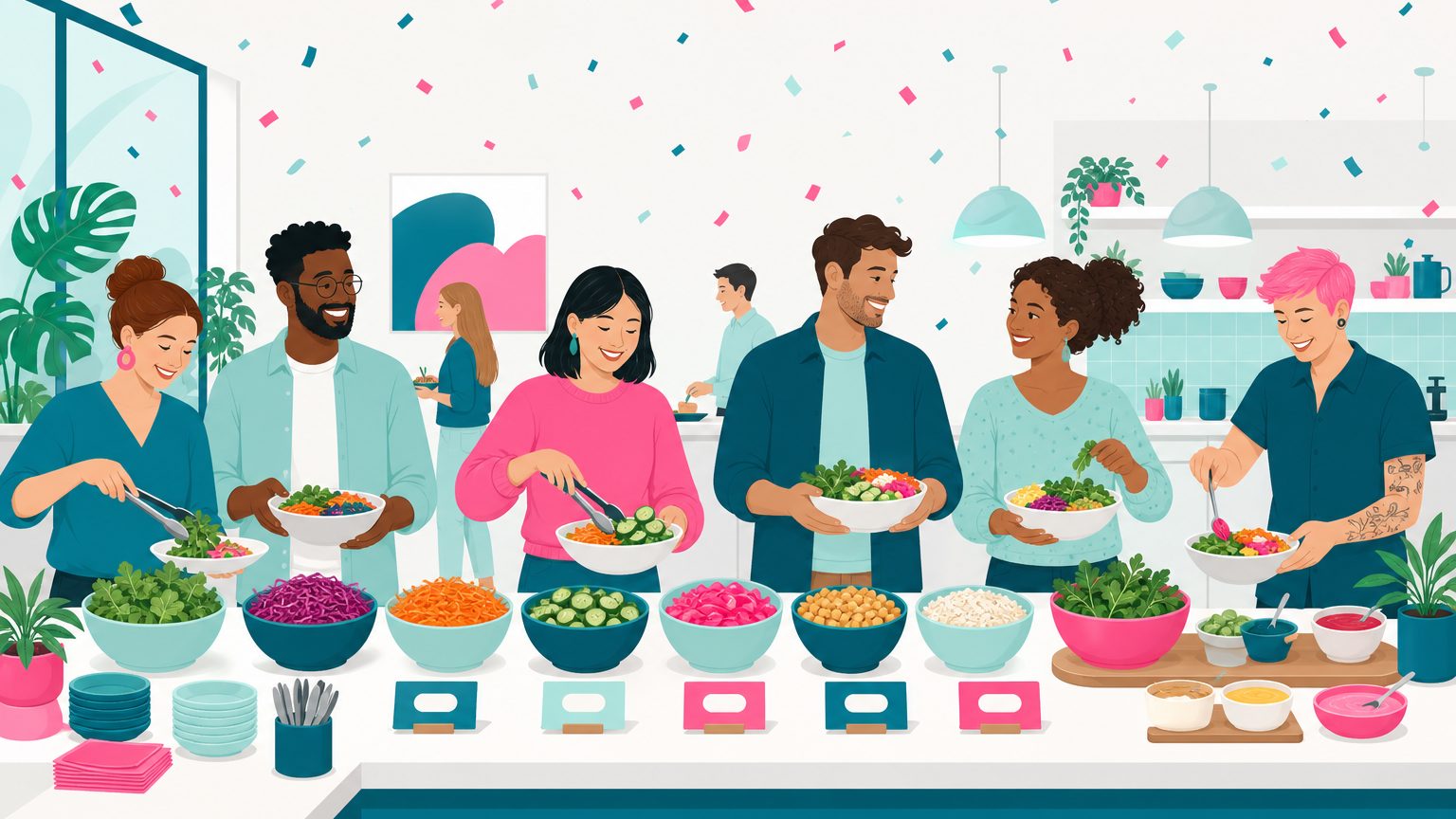
Most employee appreciation catering ideas boil down to "order sandwiches, add a veggie tray." That works for eight people. It falls apart at forty, when the line snakes past the printer and the gluten-free colleague is eating chips. Staff appreciation catering is a headcount problem with a menu attached, and the menu that works for ten is wrong for a hundred and fifty.
So this guide is organized by headcount first: 20 menus grouped by team size, per-head planning bands, a dietary and allergy checklist, eight questions to ask a caterer, a logistics timeline, and three short invites to paste. It's the food-and-logistics companion to our employee appreciation lunch ideas, which covers lunch formats, themes, and the run-of-show. Here we're talking about what goes on the table.
Small Teams Under 15: Family-Style and Make-Your-Own
With a dozen people, a good local restaurant with platters beats a formal caterer. Aim for one table, everyone sitting at once, food passed around.
- Family-style Italian. Lasagna (one pan vegetarian), chicken piccata, a big salad, roasted vegetables, garlic bread. Order for 25% more than headcount.
- Make-your-own grain bowl bar. Two bases, two proteins (grilled chicken, crispy tofu), roasted vegetables, pickles, three sauces. Covers vegan and gluten-free without singling anyone out.
- Mezze spread. Hummus, baba ghanoush, falafel, chicken skewers, tabbouleh, warm pita. Plant-forward and easy to source halal.
- Sushi and salad platters. Mixed rolls with a separate vegetarian platter, edamame, miso soup in a hot carafe. Feels like a treat at platter prices.
15–50 People: Boxed Lunches and Build-Your-Own Bars
This is where "just order a lot" stops working. Either decide portions in advance (boxed) or build a line that moves fast (bars), and give dietary-flagged items their own table.
- Three-choice boxed lunches. Sandwich, salad, or wrap, each with a side and a cookie, name-labelled from the RSVP. No queue, no cross-contact, easy to hand to whoever got pulled onto a call.
- Taco bar. Two proteins plus black beans, corn and flour tortillas, rice, toppings. Put the dairy at the end of the line so vegan plates come out clean.
- Pasta bar. Two pastas (one gluten-free, cooked separately), two sauces (one dairy-free), grilled chicken on the side, parmesan in its own bowl.
- Poke bar. Rice and greens, ahi, salmon, marinated tofu, cucumber, edamame, avocado, sauces. Ask about fish handling and keep it iced.
- Barbecue platters. Brisket or pulled pork, smoked jackfruit, cornbread, slaw, mac and cheese. Sauces hide allergens, so get the ingredient list.
50–200 People: Buffet Lines, Food Trucks, and Stations
Above fifty, throughput is the whole design problem. Each menu here feeds the room in under twenty minutes so the thank-yous aren't delivered to a line.
- Double-sided buffet. The same menu on both sides of a long table, two lines at once. Ask the caterer to staff it and refill from the back.
- Food truck pairing. One savoury truck, one dessert or coffee truck. Confirm minimums, give each team a 15-minute slot, and have the top three items pre-cooked before the first slot.
- Carving, pasta, and salad stations. Three stations in three corners. People spread out, and the salad station doubles as the full vegan and gluten-free plate if you brief it that way.
- Mediterranean buffet. Grilled chicken and lamb, falafel, rice pilaf, grilled vegetables, pita, dips. One of the easiest menus to make fully halal with a vegan plate built in.
- Wood-fired pizza oven on site. Not boxes: a mobile oven, a chef making pizzas to order, two large salads. Run the gluten-free crusts before regular dough touches the oven.
Company-Wide and Multi-Site: Rotation, Regional Partners, and Credits
When the team spans three offices and a home-office crowd, pick one theme and one per-head budget, then let each location execute locally.
- Vendor rotation. Each site picks its own caterer within the shared budget; rotate which office chooses the theme each quarter.
- Regional partner menu. One theme (say, bowls) with a local vendor per site. Similar enough that the photo thread makes sense, local enough to be good.
- Delivery credits for remote staff. A fixed credit sent the day before, same lunch window as the offices. More on making it feel equal below.
Breakfast and Afternoon Options
Shift teams, early starters, and parents on school pickup are often better served at a different hour.
- Coffee cart. A barista for two hours, with pastries, fruit, and a yogurt-and-granola bar. People linger at a cart in a way they never do at an urn.
- Dessert bar. A 3 pm spread: cookies, brownies, fruit, labelled vegan and gluten-free options, good tea. Cheap, fast, and timed to the slump.
- Ice-cream social. A scooping station with a dairy-free sorbet, toppings, and cones. Works outdoors in summer or as a closer for a half-day event.
Feeding one new hire rather than a whole team? The logic is different; see our guide to a welcome lunch for new employees.
Per-Head Planning Bands
These are planning ranges, not data. Prices swing by city, season, and delivery distance, so use them to start the budget conversation and get real quotes.
| Menu type | Common planning band (per head) | What moves the number |
|---|---|---|
| Dessert bar, coffee cart | Roughly $6–12 | Barista hours |
| Boxed lunches | Roughly $12–20 | Premium proteins, packaging |
| Build-your-own bars, family-style | Roughly $14–25 | Number of proteins, setup fees |
| Buffet lines, multi-station | Roughly $20–35 | Staffing, rentals, service hours |
| Food trucks, on-site oven | Roughly $15–30, often with a minimum | Minimums, travel |
| Remote delivery credit | $20–30 is a common band | Delivery fees eat small credits |
Add roughly 10–15% for drinks, disposables, and tip, and plan for 10% more heads than the RSVP count. For smaller gestures, see employee appreciation gifts on a budget.
Dietary and Allergy Checklist
The fastest way to turn a thank-you into an insult is for someone to find nothing they can eat. Run this for every order, however small.
- Ask in the RSVP, not at the table. One field: vegetarian, vegan, halal, kosher, gluten-free, nut-free, other. Answers go to the organizer only.
- One full plate per diet. A vegan who gets a side salad has not been fed.
- Label every dish with name, main ingredients, and major allergens. Most caterers will print cards if asked a week out.
- Separate serving utensils for every dish, and a marked end-of-line or separate table for gluten-free and nut-free items.
- Kosher and halal need the vendor, not just the menu. Source a certified vendor for those meals rather than approximating.
- Check the calendar for fasting periods and religious holidays.
- Hold back a plate for anyone stuck on a customer call.
8 Questions to Ask a Caterer
- Can you provide a written ingredient and allergen list for every dish?
- Are gluten-free items prepared and packed separately?
- Can you source certified halal or kosher meals if needed?
- What's in the quote: delivery, setup, staffing, chafing dishes, disposables, cleanup?
- What's your minimum, and what happens if headcount changes 48 hours out?
- When do you arrive, and how long will hot food hold?
- Will you label dishes, or should we print cards?
- Can you run a staggered 30-minute service for a large room, or is it a single drop?
Logistics Timeline
- 2–3 weeks out: Pick the date, confirm the room or delivery addresses, set the per-head budget, send the invite with the RSVP and dietary form.
- 10 days out: Close the RSVP, choose the menu from the headcount and diets collected, get two quotes, book, request allergen labels.
- 1 week out: Schedule remote credits and write the three to five specific thank-yous (now, not the morning of).
- 48 hours out: Confirm final headcount, post the reminder, check power and water if a truck or cart is coming.
- Day of: Food out before the start time, labels and separate utensils in place, a held plate set aside, and someone ready to stand up with the thank-yous.
Remote and Hybrid Inclusion
Catering is an office word, and remote colleagues know it. Two things fix that: a delivery credit sent the day before, in the same per-head band as the office menu, and a synchronized 15-minute lunch call where everyone eats at the same time and the thank-yous are said once to everyone. A photo thread does the rest. This applies as much to a company-wide Employee Appreciation Day as to a single team appreciation week lunch.
Invite Wording: 3 Templates
1. Email
Subject: Lunch on us, Thursday 12:00
Hi all, to thank the team for [the migration weekend], we're catering lunch Thursday at 12:00 in [room]. Please fill in the two-question RSVP (coming / dietary needs) by Friday so everyone gets a full plate. Remote colleagues get a delivery credit, and we'll do a short all-hands thank-you at 12:15.
2. Slack post
Thursday lunch is catered, and it's a thank-you for [the Q3 launch]. Taco bar in the kitchen at 12:00, delivery credits for everyone remote. RSVP + dietary needs by Friday: [link]. We'll take ten minutes at 12:15 to call out a few people by name.
3. RSVP form text
We're catering lunch on [date] to say thanks. Two quick questions: Will you join in person, remote, or not at all? Any dietary needs we should plan a full plate around (vegetarian, vegan, halal, kosher, gluten-free, nut-free, other)? Answers are seen only by [organizer].
Say Why You're Feeding Them
A well-run catering order feeds the room. It becomes appreciation when someone stands up and says, specifically, what the room did. "Thanks for all your hard work" over a buffet is forgotten before the chafing dishes are packed. "Priya rewrote the deploy script at 2 am so the rest of us could sleep" is remembered for a year. Write three to five of those before the food arrives; our employee shout-out examples are a good model.
Then keep the praise going when there's no budget line for it. Full disclosure: Propsly is ours. It's a free Slack recognition app, and teams use it to carry the lunch's thank-yous into a feed channel with a /props +10 @priya for the 2 am deploy fix #ownership, so the recognition outlives the leftovers. A pinned thread works too. The caterer handles the food; the specific thank-you is the part only you can supply.