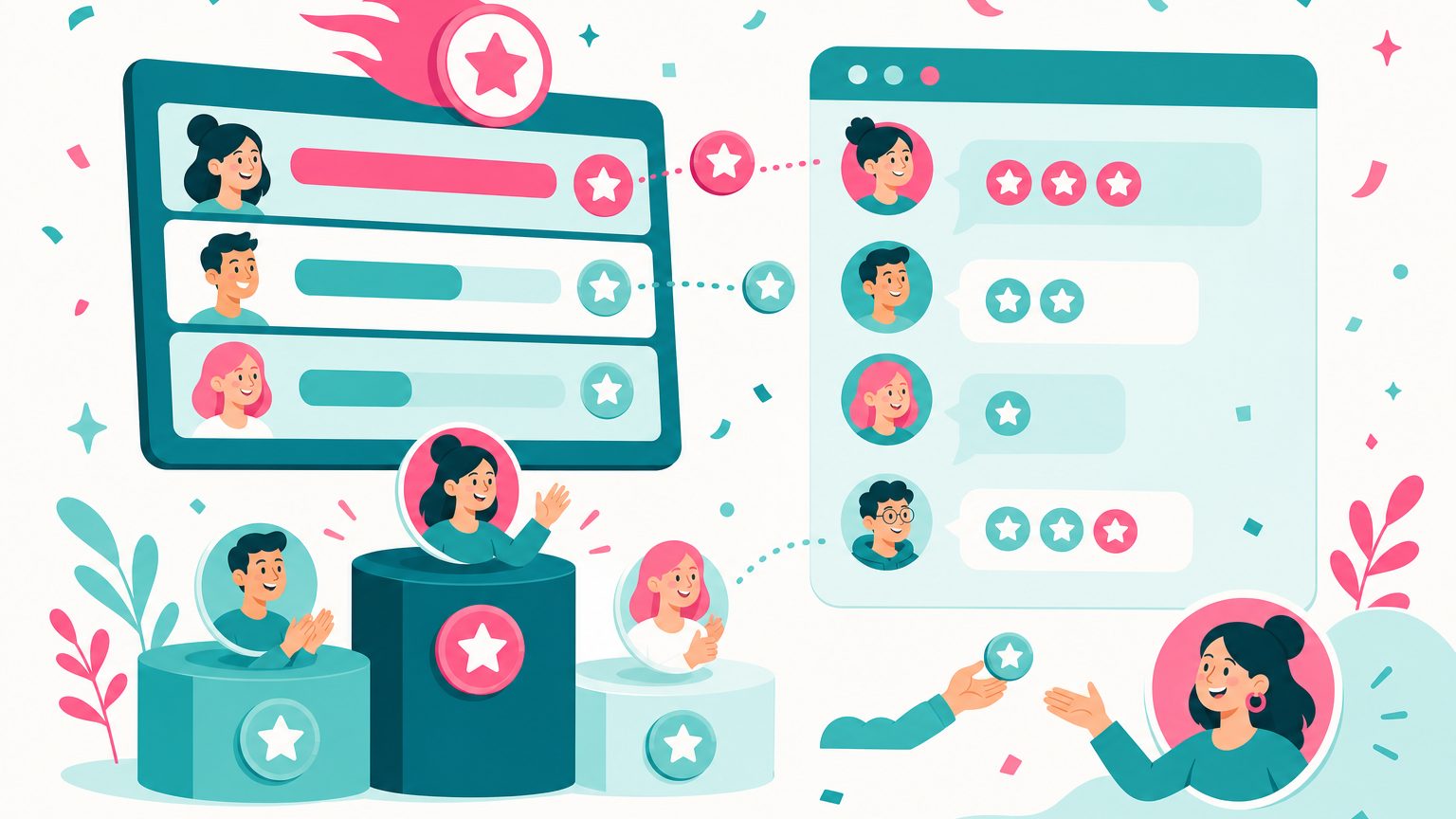
Slack gamification is the practice of wrapping game mechanics — points, leaderboards, streaks, badges, milestones — around behavior you want more of inside your Slack workspace. In practice, almost all of it is recognition: give someone points for good work, show the totals somewhere public, and celebrate the people who keep showing up.
It works. It also fails in extremely predictable ways, and the failure modes are rarely discussed by the people selling it. So this guide does both halves. First: how gamification in Slack actually works, mechanic by mechanic, with real examples from the bots that do it. Then the honest part — when leaderboards demotivate, how people game the system, and the five design rules that keep a gamified recognition program healthy past month three.
Bias disclosure up front: we build Propsly, a Slack recognition bot that uses most of these mechanics. Yes, it's ours. We'll name our own mechanics specifically so you can check our claims, and we'll be just as specific about where gamification goes wrong — including in tools like ours.
The Five Mechanics of Gamified Recognition in Slack
1. A monthly point budget
The foundational mechanic isn't the leaderboard — it's the wallet. Every person gets a fixed allowance of points to give away each month, and it resets on the first. Propsly gives every user 200 props a month on the free tier. HeyTaco hands out a daily allotment of tacos. Karma Bot, Matter, and Bonusly all run some version of the same idea.
The budget does two jobs. It makes recognition scarce, which makes it mean something — a compliment you can hand out infinitely is worth roughly what it costs. And it removes the awkward question of whether you're "allowed" to praise a colleague, because the points are already sitting in your account with an expiry date. We've written a longer argument for why the monthly reset matters, but the short version: use-it-or-lose-it beats save-it-forever every time.
2. Leaderboards
Public standings for props received, props given, or both. Usually filtered by month so the board actually turns over. This is the mechanic everyone pictures when they hear "gamification," and it's also the one most likely to backfire — more on that below.
3. Giving streaks
Streaks reward consistency instead of volume. Propsly tracks consecutive weeks in which you gave recognition to someone — with a one-week grace period, because everybody takes a vacation — and celebrates milestones at 4, 8, 12, 26, and 52 weeks in the feed channel.
Streaks are quietly the most useful mechanic in the set, because they're the only one that isn't zero-sum. Your 12-week streak doesn't cost anyone else theirs. Everyone in the company can be winning at streaks simultaneously, which is exactly the property leaderboards lack.
4. Lifetime milestones
Cumulative thresholds — 100 props received, then 500, 1,000, on up to 10,000 — that trigger a public celebration when someone crosses them. Milestones matter for a specific reason: they give long-tenured, steady contributors a moment in the spotlight even if they never top a monthly board. The person who quietly gets 30 props a month for three years should get a parade at some point.
5. The feed channel
A dedicated channel — #wins, #props, #kudos, pick your name — where every recognition event posts automatically. This is the ambient layer that makes everything else visible. Without it, gamification is a dashboard nobody opens. With it, recognition becomes something people scroll past twenty times a day. If you don't have one yet, start with our guide to setting up a recognition channel in Slack.
What This Looks Like in the Wild
HeyTaco is the best-known example: everyone gets five tacos a day, you give them in-channel with the 🌮 emoji, and a leaderboard tracks who's collected the most. Tacos convert to a rewards catalog. The mechanic is charming and the brand does a lot of the work.
Bonusly and Matter run the points-to-catalog model at a larger scale, with per-seat pricing and company-values tagging layered on. Karma Bot is the lightweight, long-running option built around @user ++ syntax.
Propsly (ours) uses the /props command, 200 points a month per person on the free tier, unlimited users, leaderboards, a feed channel, plus streaks and lifetime milestones. Automated monthly rewards — where the system picks winners and issues gift cards without an admin lifting a finger — live on the $50/month Pro tier, flat, not per seat.
For a fuller side-by-side of what each tool actually does, see our roundup of the best employee recognition tools for Slack or the specific HeyTaco alternatives comparison.
Now the Honest Half: When Gamification Backfires
Failure mode 1: the same three people win every month
This is the most common way a Slack leaderboard dies. Recognition naturally concentrates on people whose work is visible — the person who ships the customer-facing feature, the one who posts in the busy channel, the extrovert on a distributed team. Meanwhile the person maintaining the build system or handling the unglamorous escalations gets nothing, because nobody sees the work.
Month one, the board is exciting. Month four, everyone knows who's going to be on top, and the 80% of people who know they'll never crack the list stop looking. A leaderboard that always shows the same names isn't a game — it's a status announcement. We dug into the data patterns behind this in fixing recognition inequality.
Failure mode 2: people game the system
Any metric that gets attached to a reward gets optimized. In recognition programs that means reciprocity rings — I give you 50, you give me 50, we both look great — plus end-of-month point dumps where someone burns their entire remaining balance on a Friday afternoon with a message that says "thanks for everything!" And once cash-equivalent rewards enter the picture, the gaming gets more deliberate, because now it's worth real money.
Failure mode 3: extrinsic rewards crowd out intrinsic motivation
This is the deepest problem and the one tools can't fully solve. The research on overjustification is decades old and consistent: when you attach an external reward to something people were already doing for internal reasons, the internal reason can atrophy. Pay someone to do a thing they enjoyed and they may enjoy it less.
Applied to recognition: if "thank you" becomes "thank you, worth $4.50," you've converted a social act into a transaction. People start calculating. The heartfelt paragraph gets replaced by a point transfer. You can see this happening when message text gets shorter month over month while volume stays flat.
Five Design Rules That Keep It Healthy
None of this means skip gamification. It means design it with the failure modes in mind. Five rules, in order of how much they matter:
- Keep points scarce and expiring. A monthly budget that resets forces prioritization and prevents hoarding. Unlimited points are worthless points.
- Peer-given only. Manager-only recognition reproduces the org chart and turns the program into performance review theater. Peer-to-peer surfaces work managers can't see — which is most of it, given that roughly 70% of team-engagement variance traces back to the manager (Gallup). Let the whole team be the sensor network.
- Celebrate breadth, not just volume. This is the direct antidote to failure mode 1. Run a "most unique recipients" board alongside "most points received." Celebrate streaks, which everyone can win at once. Highlight first-time recognitions. Our guide to recognition without playing favorites goes deeper on structuring this.
- Don't make points cash-equivalent. The moment a point has a published dollar value, people do arithmetic instead of appreciation. Rewards are fine — a monthly gift card for a standout contributor is genuinely motivating — but keep the exchange rate fuzzy and periodic rather than instant and precise.
- Spotlight cross-team giving. Recognition that crosses a team boundary is the highest-signal event in the whole system: it means someone noticed work outside their own silo. Call it out explicitly. It's also your best early indicator of collaboration health.
The Diagnostic: Is Your Gamification Working?
Four questions, answerable in about ten minutes with any decent recognition tool's analytics:
- What share of people gave recognition at least once this month? Below 30% and you have a small, enthusiastic clique, not a program.
- How many distinct people received recognition? Compare to headcount. If the top 10% of recipients hold more than half the points, you're concentrating.
- Is the median message getting shorter? Shrinking message length with flat volume is the extrinsic-crowding-out signal.
- What fraction of gives cross a team boundary? Under 20% and your recognition is mirroring your silos.
The stakes aren't abstract. Employees who feel inadequately recognized are about twice as likely to say they'll leave within a year (Gallup/Workhuman), and organizations with strong recognition cultures see up to 31% lower voluntary turnover (Deloitte/Bersin). Against a replacement bill that starts at roughly a third of salary and climbs from there, a recognition program that actually sticks pays for itself many times over. One that gets abandoned in month three costs you the credibility to try again.
Gamification is a delivery mechanism, not a strategy. The points are scaffolding for a habit — the habit of noticing colleagues out loud. Build the scaffolding so it supports the habit rather than replacing it, and the game takes care of itself. For practical starting mechanics, see how to give kudos in Slack and our collection of Slack rituals for distributed teams.